

Q1 2026 Threat Landscape Report
Discover the impact of vulnerability exploitation, geopolitical cyber activity, ransomware evolution, and cybercriminal infrastructure.
Why AI-powered cyberattacks matter
AI does not replace traditional attack techniques, rather, it makes many of them easier to launch, adapt, and repeat. That matters because defenders are not dealing with a completely new category of risk. They are dealing with familiar attack patterns that now move faster and often look more convincing.
For example, an attacker no longer needs to spend as much time writing a believable phishing message, researching a target, or adjusting wording for a specific industry. AI can help automate parts of that process. It can summarize public information, generate different message variants, and refine content based on the target’s role, language, or location. That can make phishing attacks and spear phishing attacks more efficient.
AI also changes the economics of cyberattacks. When it takes less time and effort to create convincing lures, test variations, or scan for weaknesses, attackers can try more campaigns with fewer resources. In practice, that can increase the number of attempts defenders have to filter, investigate, and contain.
A few practical shifts stand out:
- Faster content generation: Attackers can create emails, fake messages, scripts, or voice prompts quickly.
- Better targeting: AI can help tailor attacks to a company, team, or individual.
- More iteration: Adversaries can test and revise attack content at a higher volume.
- Lower barriers to entry: Less experienced attackers may be able to launch more polished campaigns.
This is one reason AI-powered cyberattacks are increasingly discussed alongside broader topics like artificial intelligence in cybersecurity and generative AI in cybersecurity. The concern is not just that AI exists, rather that AI can help attackers operationalize familiar tactics more effectively.
How AI-powered cyberattacks work
Most AI-powered cyberattacks follow a familiar pattern. The difference is that AI can improve one or more stages of the attack chain. In some cases, it helps with research and preparation. In others, it improves delivery, evasion, or follow-on activity after initial access.
A simple way to think about the process is:
- Input collection: The attacker gathers data from public sources, previous breaches, social media, company websites, or technical scans.
- AI-assisted generation or analysis: The attacker uses AI to summarize information, write content, create scripts, analyze patterns, or generate convincing impersonation material.
- Attack delivery: The attacker sends the phishing message, launches the social engineering attempt, deploys malware, or automates credential attacks.
- Adaptation and optimization: Based on what works, the attacker adjusts timing, language, payloads, or delivery methods.
- Post-compromise activity: AI may also support reconnaissance, privilege escalation planning, or faster triage of stolen information.
AI is often not the attack itself, but the acceleration layer around the attack. That is an important distinction, because it helps security teams focus on where AI changes risk the most.
This workflow also helps separate AI-powered cyberattacks from adjacent concepts like adversarial AI and dark AI. In an AI-powered cyberattack, the attacker uses AI to improve offensive operations. In adversarial AI, the attack may target the AI system itself, such as poisoning training data or manipulating model behavior.
Key components
To understand AI-powered cyberattacks, it helps to break them into a few common components. Not every attack includes all of these, but most include some combination of them.
- Data inputs: Attackers need source material. That might include public company information, employee details, leaked credentials, prior email content, or technical scan data.
- AI model or system: This is the tool that helps generate, classify, summarize, imitate, or automate tasks. In some cases, it is a public model. In others, it may be a customized or restricted-use system.
- Automation layer: This connects AI output to action. It may help send messages at scale, rotate content, test payloads, or prioritize targets.
- Delivery channel: Common channels include email, messaging apps, collaboration tools, websites, voice calls, or malware distribution paths.
- Feedback loop: Attackers often refine output based on open rates, responses, detections, or technical failures. AI can most certainly speed up that iteration cycle.
These components matter because they show where defenders can interrupt the process. For example, improving identity controls, user awareness, and email filtering may reduce delivery success, while better threat detection and incident response can reduce the impact if delivery succeeds.
Two Types of AI Cyberattacks
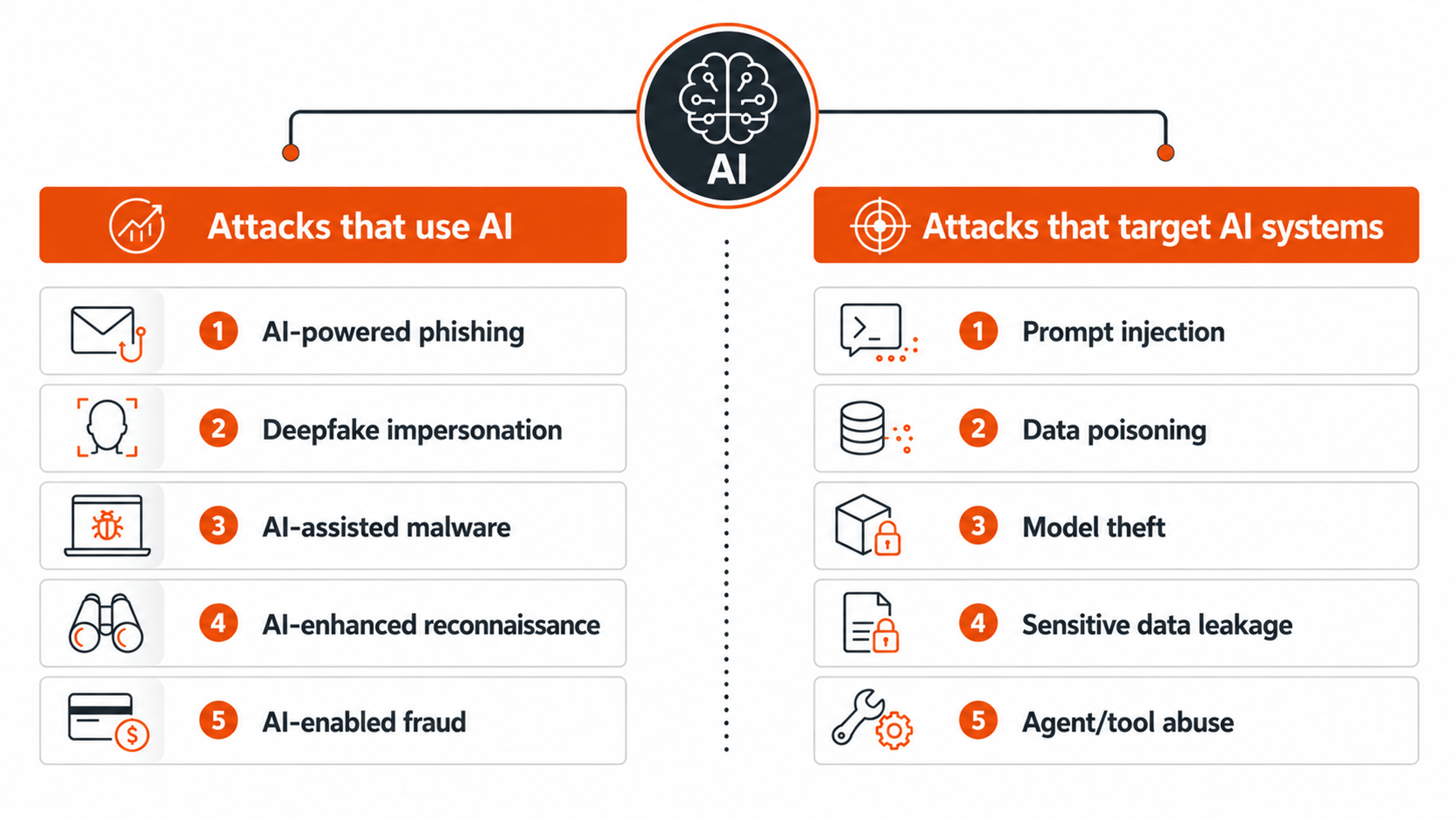
Examples of AI-powered cyberattacks
The clearest way to understand this topic is to look at how AI shows up in real attack scenarios.
AI-generated phishing
An attacker gathers public information about a finance team, then uses AI to draft a message that sounds like an internal request from an executive. The language is polished, the tone is natural, and the timing fits the company’s workflow. The goal is still credential theft, fraud, or initial access, but the content is more believable and easier to produce at scale.
Deepfake-enabled social engineering
An attacker uses AI-generated audio or video to imitate a known person, such as an executive or business partner. The fake content may be used to pressure an employee into transferring money, resetting credentials, or sharing sensitive information. This is still social engineering, but with stronger impersonation capability.
AI-assisted malware development or variation
AI can help attackers generate or revise code, create script variants, or speed up documentation searches that support malware attacks. That does not mean AI independently creates sophisticated malware end to end in every case. It does mean some attackers can use it to shorten development time, create variations, or experiment more quickly.
AI-driven reconnaissance
Before launching an attack, adversaries often need to understand the target. AI can help summarize large amounts of public information, identify likely high-value individuals, classify exposed assets, or organize stolen data for follow-up use. That makes reconnaissance more efficient and can help attackers prioritize the next move.
How AI-powered cyberattacks fit into security operations
AI-powered cyberattacks do not sit in isolation. They overlap with several core security disciplines, which is why this topic belongs in a broader operational context.
First, they connect directly to phishing defense and identity protection. Many AI-enhanced attacks still aim to steal credentials, trick users, or abuse trust. That means user-focused controls still matter. Security awareness training remains relevant, but teams may need to update examples and exercises to reflect more realistic impersonation attempts.
Second, they affect detection and triage. If attackers can generate more campaigns, create more convincing content, or rapidly change delivery patterns, analysts may face higher alert volume and less obvious signals. That makes strong detection engineering, contextual investigation, and efficient escalation paths more important.
Third, this topic overlaps with threat intelligence. Teams need to understand how attacker tradecraft is evolving, which tools are being used, and which techniques are appearing across phishing, malware, and social engineering campaigns.
Finally, AI-powered cyberattacks fit into a broader conversation about cyber resilience. The point is not to block every possible AI-assisted action. The goal is to reduce exposure, detect suspicious behavior quickly, and respond in a way that limits business impact.