

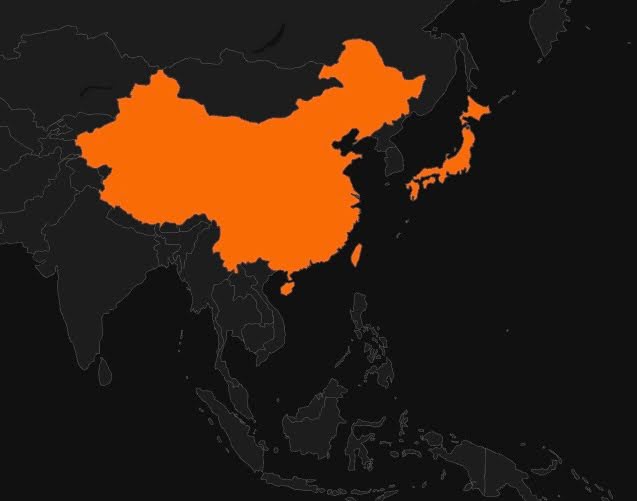
Rapid7 Labs, together with the Rapid7 MDR team, has uncovered a sophisticated campaign attributed to the Chinese APT group Lotus Blossom. Active since 2009, the group is known for its targeted espionage campaigns primarily impacting organizations across Southeast Asia and more recently Central America, focusing on government, telecom, aviation, critical infrastructure, and media sectors.
Our investigation identified a security incident stemming from a sophisticated compromise of the infrastructure hosting Notepad++, which was subsequently used to deliver a previously undocumented custom backdoor, which we have dubbed Chrysalis.
⠀
⠀
Beyond the discovery of the new implant, forensic evidence led us to uncover several custom loaders in the wild. One sample, “ConsoleApplication2.exe”, stands out for its use of Microsoft Warbird, a complex code protection framework, to hide shellcode execution. This blog provides a deep technical analysis of Chrysalis, the Warbird loader, and the broader tactic of mixing straightforward loaders with obscure, undocumented system calls.
Initial access vector: Notepad++ and update.exe
Forensic analysis conducted by the MDR team suggests that the initial access vector aligns with publicly disclosed abuse of the Notepad++ distribution infrastructure. While reporting references both plugin replacement and updater-related mechanisms, no definitive artifacts were identified to confirm exploitation of either. The only confirmed behavior is that execution of “notepad++.exe” and subsequently “GUP.exe” preceded the execution of a suspicious process “update.exe” which was downloaded from 95.179.213.0.
Analysis of update.exe
⠀
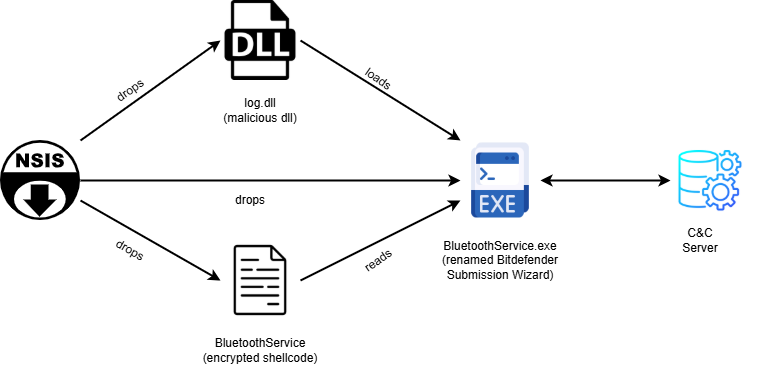
Analysis of “update.exe” shows the file is actually an NSIS installer, a tool commonly used by Chinese APT to deliver initial payload.
The following are the extracted NSIS installer files:
[NSIS].nsi
- Description: NSIS Installation script
- SHA-256: 8ea8b83645fba6e23d48075a0d3fc73ad2ba515b4536710cda4f1f232718f53e
BluetoothService.exe
Description: renamed Bitdefender Submission Wizard used for DLL sideloading
- SHA-256: 2da00de67720f5f13b17e9d985fe70f10f153da60c9ab1086fe58f069a156924
BluetoothService
- Description: Encrypted shellcode
- SHA-256: 77bfea78def679aa1117f569a35e8fd1542df21f7e00e27f192c907e61d63a2e
log.dll
- Description: Malicious DLL sideloaded by BluetoothService.exe
- SHA-256: 3bdc4c0637591533f1d4198a72a33426c01f69bd2e15ceee547866f65e26b7ad
⠀
Installation script is instructed to create a new directory “Bluetooth” in “%AppData%” folder, copy the remaining files there, change the attribute of the directory to HIDDEN and execute BluetoothService.exe.
DLL sideloading
Shortly after the execution of BluetoothService.exe, which is actually a renamed legitimate Bitdefender Submission Wizard abused for DLL sideloading, a malicious log.dll was placed alongside the executable, causing it to be loaded instead of the legitimate library. Two exported functions from log.dll are called by Bitdefender Submission Wizard: LogInit and LogWrite.
LogInit and LogWrite - Shellcode load, decrypt, execute
LogInit loads BluetoothService into the memory of the running process.
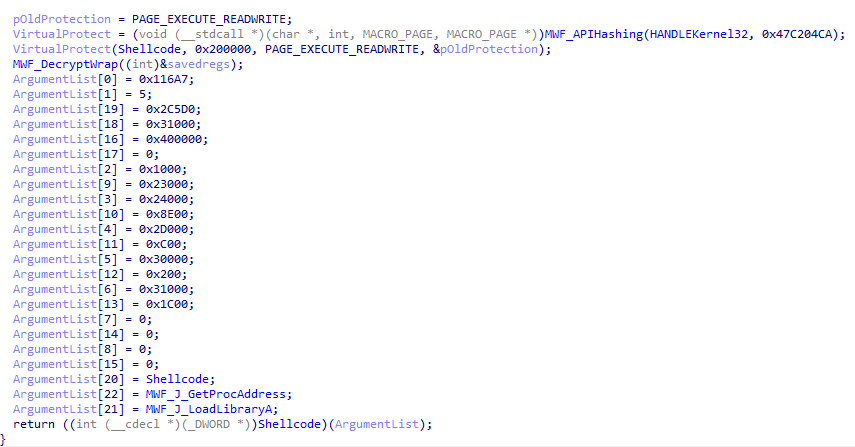
LogWrite has a more sophisticated goal – to decrypt and execute the shellcode.
The decryption routine implements a custom runtime decryption mechanism used to unpack encrypted data in memory. It derives key material from previously calculated hash value and applies a stream‑cipher–like algorithm rather than standard cryptographic APIs. At a high level, the decryption routine relies on a linear congruential generator, with the standard constants 0x19660D and 0x3C6EF35F, combined with several basic data transformation steps to recover the plaintext payload.
Once decrypted, the payload replaces the original buffer and all temporary memory is released. Execution is then transferred to this newly decrypted stage, which is treated as executable code and invoked with a predefined set of arguments, including runtime context and resolved API information.
IAT resolution
Log.dll implements an API hashing subroutine to resolve required APIs during execution, reducing the likelihood of detection by antivirus and other security solutions.
API hashing subroutine
The hashing algorithm will hash export names using FNV‑1a (fnv-1a hash 0x811C9DC5, fnv-1a prime 0x1000193 observed), then apply a MurmurHash‑style avalanche finalizer (murmur constant 0x85EBCA6B observed), and compare the result to a salted target hash.
Analysis of the Chrysalis backdoor
The shellcode, once decrypted by log.dll, is a custom, feature-rich backdoor we've named “Chrysalis”. Its wide array of capabilities indicates it is a sophisticated and permanent tool, not a simple throwaway utility. It uses legitimate binaries to sideload a crafted DLL with a generic name, which makes simple filename-based detection unreliable. It relies on custom API hashing in both the loader and the main module, each with its own resolution logic. This is paired with layered obfuscation and a fairly structured approach to C2 communication. Overall, the sample looks like something that has been actively developed over time, and we’ll be keeping an eye on this family and any future variants that show up.
Decryption of the main module
Once the execution is passed to decrypted shellcode from log.dll, malware starts with decryption of the main module via a simple combination of XOR, addition and subtraction operations, with a hardcoded key gQ2JR&9;. See below the pseudocode of decryption routine:
⠀
char XORKey[8] = "gQ2JR&9;";
DWORD counter = 0;
DWORD pos = BufferPosition;

while (counter < size) {
    BYTE k = XORKey[counter & 7];
    BYTE x = encrypted[pos];

    x = x + k;
    x = x ^ k;
    x = x - k;

    decrypted[pos] = x;

    pos++;
    counter++;
}
⠀
XOR operation is performed 5 times in total, suggesting a section layout similar to PE format. Following the decryption, malware will proceed to yet another dynamic IAT resolution using LoadLibraryA to acquire a handle to Kernel32.dll and GetProcAddress. Once exports are resolved, the jump is taken to the main module.
Main module
The decrypted module is a reflective PE-like module that executes the MSVC CRT initialization sequence before transferring control to the program’s main entry point. Once in the Main function, the malware will dynamically load DLLs in the following order: oleaut32.dll, advapi32.dll, shlwapi.dll, user32.dll, wininet.dll, ole32.dll and shell32.dll.
Names of targeted DLLs are constructed on the run, using two separate subroutines. These two subroutines implement a custom, position-dependent character obfuscation scheme. Each character is transformed using a combination of bit rotations, conditional XOR operations, and index-based arithmetic, ensuring that identical characters encrypt differently depending on their position. The second routine reverses this process at runtime, reconstructing the original plaintext string just before it is used. The purpose of these two functions is not only to conceal strings, but also to intentionally complicate static analysis and hinder signature-based detection.
After the DLL name is reconstructed, the Main module implements another, more sophisticated API hashing routine.
API hashing subroutine
⠀
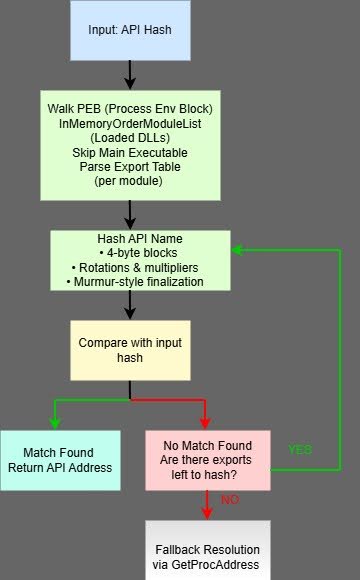
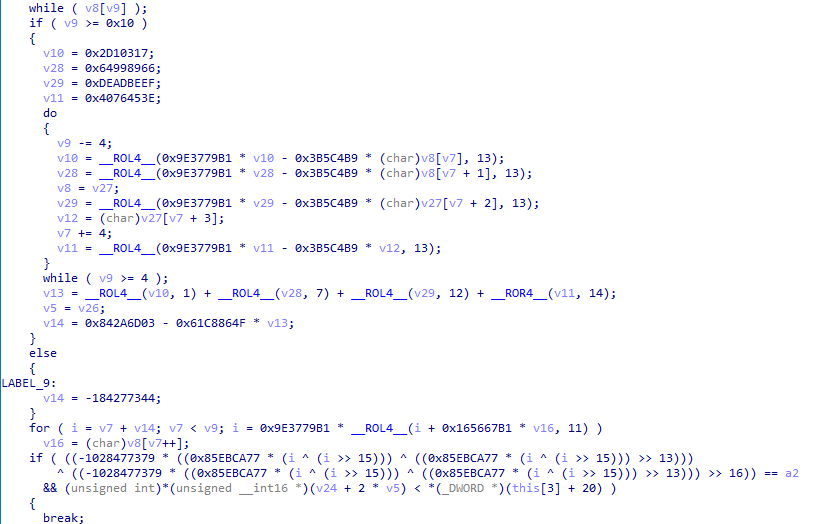
The first difference between this and the API hashing routine used by the loader is that this subroutine accepts only a single argument: the hash of the target API. To obtain the DLL handle, the malware walks the PEB to reach the InMemoryOrderModuleList, then parses each module’s export table, skipping the main executable, until it resolves the desired API. Instead of relying on common hashing algorithms, the routine employs multi-stage arithmetic mixing with constants of MurmurHash-style finalization. API names are processed in 4-byte blocks using multiple rotation and multiplication steps, followed by a final diffusion phase before comparison with the supplied hash. This design significantly complicates static recovery of resolved APIs and reduces the effectiveness of traditional signature-based detection. As a fallback, the resolver supports direct resolution via GetProcAddress if the target hash is not found through the hashing method. The pointer to GetProcAddress is obtained earlier during the “main module preparation” stage.
⠀
Config decryption
The next step in the malware’s execution is to decrypt the configuration. Encrypted configuration is stored in the BluetoothService file at offset 0x30808 with the size of 0x980. Algorithm for the decryption is RC4 with the key qwhvb^435h&*7. This revealed the following information:
- Command and Control (C2) url: https://api.skycloudcenter.com/a/chat/s/70521ddf-a2ef-4adf-9cf0-6d8e24aaa821
- Name of the module: BluetoothService
- User agent: Mozilla/5.0 (Windows NT 10.0; Win64; x64) AppleWebKit/537.36 (KHTML, like Gecko) Chrome/80.0.4044.92 Safari/537.36
The URL structure of the C2 is interesting, especially the section /a/chat/s/{GUID}), which appears to be the identical format used by Deepseek API chat endpoints. It looks like the actor is mimicking the traffic to stay below the radar.
Decrypted configuration doesn’t give much useful information besides the C2. The name of the module is too generic and the user agent belongs to Google Chrome browser. The URL resolves to 61.4.102.97, IP address based in Malaysia. At the time of the writing of this blog, no other file has been seen to communicate with this IP and URL.
Persistence and command-line arguments
To determine the next course of action, malware checks command-line arguments highlighted in Table 1 and chooses one of four potential paths. If the amount of the command-line arguments is greater than two, the process will exit. If there is no additional argument, persistence is set up primarily via service creation or registry as a fall back mechanism.
See Table 2 below:
Argument | Mode | Action |
(None) | Installation | Installs persistence (Service or Registry) pointing to binary with -i flag, then terminates. |
-i | Launcher | Spawns a new instance of itself with the -k flag via ShellExecuteA, then terminates. |
-k | Payload | Skips installation checks and executes the main malicious logic (C2 & Shellcode). |
⠀
With the expected arguments present, the malware proceeds to its primary functionality - to gather information about the infected asset and initiate the communication with C2.
Information gathering and C2 communication
A mutex Global\\Jdhfv_1.0.1 is registered to enforce single instance execution on the host. If it already exists, malware is terminated. If the check is clear, information gathering begins by querying for the following: current time, installed AVs, OS version, user name and computer name. Next, computer name, user name, OS version and string 1.01 are concatenated and the data are hashed using FNV-1A. This value is later turned into its decimal ascii representation and used most likely as a unique identifier of the infected host.
Final buffer uses a dot as delimiter and follows this pattern:
⠀
<UniqueID>.<ComputerName>.<UserName>.<OSVersion>.<127.0.0.1>.<AVs>.<DateAndTime>⠀
The last piece of information added to the beginning of the buffer is a string 4Q. The buffer is then RC4 encrypted with the key vAuig34%^325hGV.
Following data encryption, the malware establishes an internet connection using previously mentioned user agent and C2 api.skycloudcenter.com over port 443. Data is then transferred via HttpSendRequestA using the POST method. Response from the server is then read to a temporary buffer which is later decrypted using the same key vAuig34%^325hGV.
Response and command processing
Note: C2 server was already offline during the initial analysis, preventing recovery of any network data. As a result, and due to the complexity of the malware, parts of the following analysis may contain minor inaccuracies.
The response from the C2 undergoes multiple checks before further processing. First, the HTTP response code is compared against the hardcoded value 200 (0xC8), indicating a successful request, followed by a validation of the associated WinInet handle to ensure no error occurred. The malware then verifies the integrity of the received payload and execution proceeds only if at least one valid structure is detected. Next, malware looks into the response data for a small tag to determine what to do next. Tag is used as a condition for a switch statement with 16 possible cases. The default case will simply set up a flag to TRUE. Setting up this flag will result in completely jumping out of the switch. Other switch cases includes following options:
⠀
Char representation | Hex representation | Purpose |
4T | 0x3454 | Spawn interactive shell |
4U | 0x3455 | Send ‘OK’ to C2 |
4V | 0x3456 | Create process |
4W | 0x3457 | Write file to disk |
4X | 0x3458 | Write chunk to open file |
4Y | 0x3459 | Read & send data |
4Z | 0x345A | Break from switch |
4\\ | 0x345C | Uninstall / Clean up |
4] | 0x345D | Sleep |
4_ | 0x345F | Get info about logical drives |
4` | 0x3460 | Enumerate files information |
4a | 0x3661 | Delete file |
4b | 0x3662 | Create directory |
4c | 0x3463 | Get file from C2 |
4d | 0x3464 | Send file to C2 |
⠀
4T - The malware implements a fully interactive cmd.exe reverse shell using redirected pipes. Incoming commands from the C2 are converted from UTF‑8 to the system OEM code page before being written to the shell’s standard input, while a dedicated thread continuously reads shell output, converts it from OEM encoding to UTF‑8 using GetOEMCP API, and forwards the result back to the C2.
4V - This option allows remote process execution by invoking CreateProcessW on a C2-supplied command line and relaying execution status back to the C2.
4W - This option implements a remote file write capability, parsing a structured response containing a destination path and file contents, converting encodings as necessary, writing the data to disk, and returning a formatted status message to the command-and-control server.
4X - Similar to the previous switch, it supports a remote file-write capability, allowing the C2 to drop arbitrary files on the victim system by supplying a UTF-8 filename and associated data blob.
4Y - Switch implements a remote file-read capability. It opens a specified file with, retrieves its size, reads the entire contents into memory, and transmits the data back to the C2.
4\\ - The option implements a full self-removal mechanism. It deletes auxiliary payload files, removes persistence artifacts from both the Windows Service registry hive and the Run key, generates and executes a temporary batch file u.bat to delete the running executable after termination, and finally removes the batch script itself.
4_ - Here malware enumerates information about logical drivers using GetLogicalDriveStringsA and GetDriveTypeA APIs and sends the information back to the C2.
4` - This switch option shares similarities with previously analyzed data exfiltration function - 4Y. However, its primary purpose differs. Instead of transmitting preexisting data, it enumerates files within a specified directory, collects per-file metadata (timestamps, size, and filename), serializes the results into a custom buffer format, and sends the aggregated listing to the C2.
4a - 4b - 4c - 4d - In the last 4 cases, malware implements a custom file transfer protocol over its C2 channel. Commands 4a and 4b act as control messages used to initialize file download and upload operations respectively, including file paths, offsets, and size validation. Once initialized, the actual data transfer occurs in a chunked fashion using commands 4c (download) and 4d (upload). Each chunk is wrapped in a fixed-size 40-byte response structure, validated for successful HTTP status and correct structure count before processing. Transfers continue until the C2 signals completion via a non-zero termination flag, at which point file handles and buffers are released.
Additional artifacts discovered on the infected host
During the initial forensics analysis of the affected asset, Rapid7’s MDR team observed execution of following command:
⠀
C:\ProgramData\USOShared\svchost.exe-nostdlib -run
C:\ProgramData\USOShared\conf.c
⠀
The retrieved folder “USOShared” from the infected asset didn’t contain svchost.exe but it contained “libtcc.dll” and “conf.c”. The hash of the binary didn’t match any known legitimate version but the command line arguments and associated “libtcc.dll” suggested that svchost.exe is in fact renamed Tiny-C-Compiler. To confirm this, we replicated the steps of the attacker successfully loaded shellcode from “conf.c” into the memory of “tcc.exe”, confirming our previous hypothesis.
Analysis of conf.c
The C source file contains a fixed size (836) char buffer containing shellcode bytes which is later casted to a function pointer and invoked. The shellcode is consistent with 32-bit version of Metasploit’s block API.
The shellcode loads Wininet.dll using LoadLibraryA, resolves Internet-related APIs such as InternetConnectA and HttpSendRequestA, and downloads a file from api.wiresguard.com/users/admin. The file is read into a newly allocated buffer, and execution is then transferred to the start of the 2000-byte second-stage shellcode.
⠀
⠀
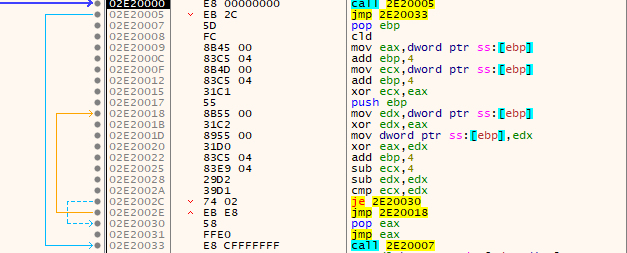
This stub is responsible for decrypting the next payload layer and transferring execution to it. It uses a rolling XOR-based decryption loop before jumping directly to the decrypted code.
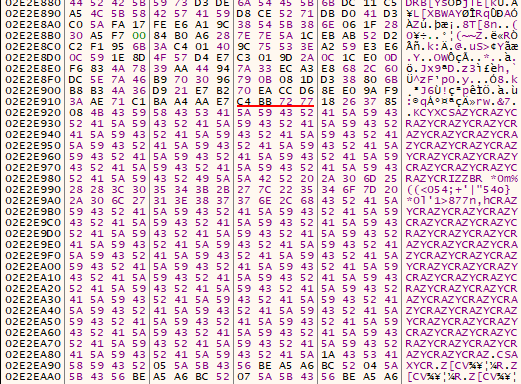
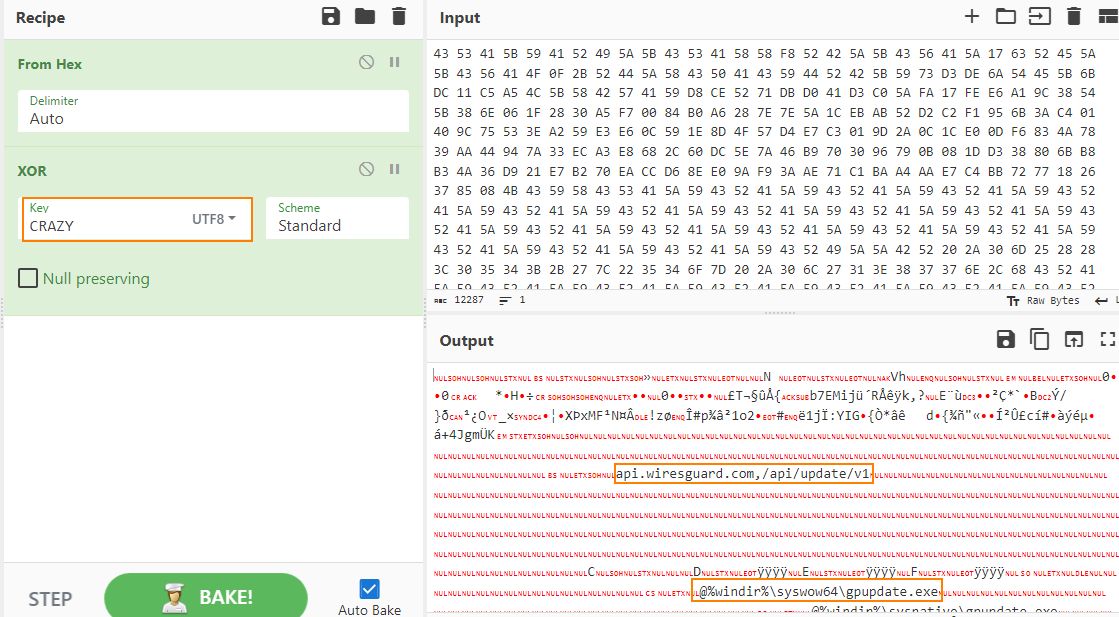
A quick look into the decrypted buffer revealed an interesting blob with a repeated string CRAZY, hinting at an additional XORed layer, later confirmed by a quick test.
⠀
⠀
⠀
Parsing of the decrypted configuration data confirms that retrieved shellcode is Cobalt Strike (CS) HTTPS beacon with http-get api.wiresguard.com/update/v1 and http-post api.wiresguard.com/api/FileUpload/submit urls.
Analysis of the initial evidence revealed a consistent execution chain: a loader embedding Metasploit block_api shellcode that downloads a Cobalt Strike beacon. The unique decryption stub and configuration XOR key CRAZY allowed us to pivot into an external hunt, uncovering additional loader variants.
⠀
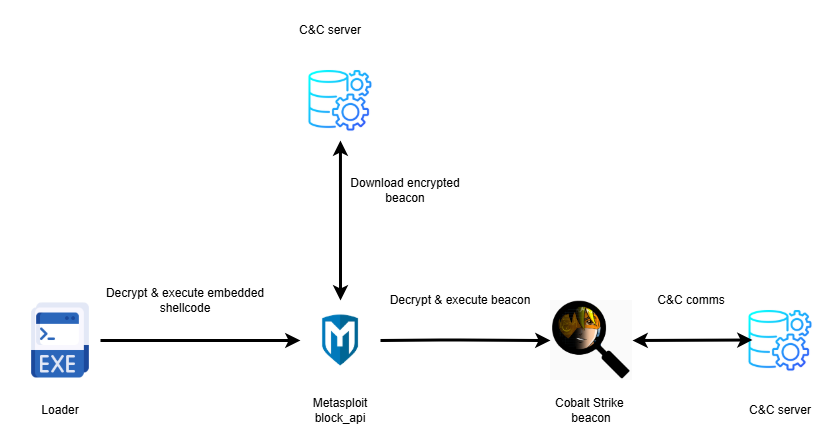
Variation of loaders and shellcode
In the last year, four similar files were uploaded to public repositories.
Loader 1:
SHA-256: 0a9b8df968df41920b6ff07785cbfebe8bda29e6b512c94a3b2a83d10014d2fd
Shellcode SHA-256: 4c2ea8193f4a5db63b897a2d3ce127cc5d89687f380b97a1d91e0c8db542e4f8
User Agent: Mozilla/5.0 (Macintosh; Intel Mac OS X 10_15_7) AppleWebKit/537.36 (KHTML, like Gecko) Chrome/92.0.4472.114 Safari/537.36
URL hosting CS beacon: http://59[.]110.7.32:8880/uffhxpSy
CS http-get URL: http://59[.]110.7.32:8880/api/getBasicInfo/v1
CS http-post URL: http://59[.]110.7.32:8880/api/Metadata/submit
Loader 2:
SHA-256: e7cd605568c38bd6e0aba31045e1633205d0598c607a855e2e1bca4cca1c6eda
Shellcode SHA-256: 078a9e5c6c787e5532a7e728720cbafee9021bfec4a30e3c2be110748d7c43c5
User Agent: Mozilla/5.0 (Macintosh; Intel Mac OS X 10_15_7) AppleWebKit/537.36 (KHTML, like Gecko) Chrome/92.0.4472.114 Safari/537.36
URL hosting CS beacon: http://124[.]222.137.114:9999/3yZR31VK
CS http-get URL: http://124[.]222.137.114:9999/api/updateStatus/v1
CS http-post URL: http://124[.]222.137.114:9999/api/Info/submit
Loader 3:
SHA-256: b4169a831292e245ebdffedd5820584d73b129411546e7d3eccf4663d5fc5be3
Shellcode SHA-256: 7add554a98d3a99b319f2127688356c1283ed073a084805f14e33b4f6a6126fd
User Agent: Mozilla/5.0 (Windows NT 10.0; Win64; x64) AppleWebKit/537.36 (KHTML, like Gecko) Chrome/134.0.0.0 Safari/537.36
URL hosting CS beacon: https://api[.]wiresguard[.]com/users/system
CS http-get URL: https://api[.]wiresguard[.]com/api/getInfo/v1
CS http-post URL: https://api[.]wiresguard[.]com/api/Info/submit
Loader 4:
SHA-256: fcc2765305bcd213b7558025b2039df2265c3e0b6401e4833123c461df2de51a
Shellcode SHA-256: 7add554a98d3a99b319f2127688356c1283ed073a084805f14e33b4f6a6126fd
User Agent: Mozilla/5.0 (Windows NT 10.0; Win64; x64) AppleWebKit/537.36 (KHTML, like Gecko) Chrome/134.0.0.0 Safari/537.36
URL hosting CS beacon: https://api[.]wiresguard[.]com/users/system
CS http-get URL: https://api[.]wiresguard[.]com/api/getInfo/v1
CS http-post URL: https://api[.]wiresguard[.]com/api/Info/submit
⠀
From all the loaders we analyzed, Loader 3 piqued our interest for three reasons - shellcode encryption technique, execution , and almost identical C2 to beacon that was found on the infected asset. All the previous samples used a pretty common technique to execute the shellcode - decrypt embedded shellcode in user space, change the protection of memory region to executable state, and invoke decrypted code via CreateThread / CreateRemoteThread; Loader 3 (original name “ConsoleApplication2.exe”) violates this approach.
Analysis of Loader 3 - ConsoleApplication2.exe
At the first glance, the logic of the sample is straightforward: Load the DLL clipc.dll, overwrite first 0x490 bytes, change the protection to PAGE_EXECUTE_READ (0x20), and then invoke NtQuerySystemInformation. Two interesting notes to highlight here - bytes copied into the memory region of clipc.dll are not valid shellcode and NtquerySystemInformation is used to “Retrieve the specified system information”, not to execute code.
⠀
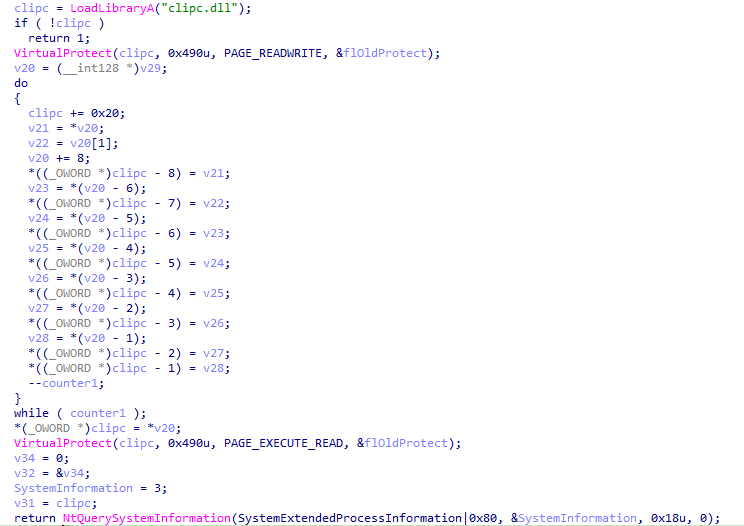
⠀
Looking into the copied data reveals two “magic numbers” DEADBEEF and CAFEAFE, but nothing else. However, the execution of shellcode is somehow successful, so what’s going on?
⠀
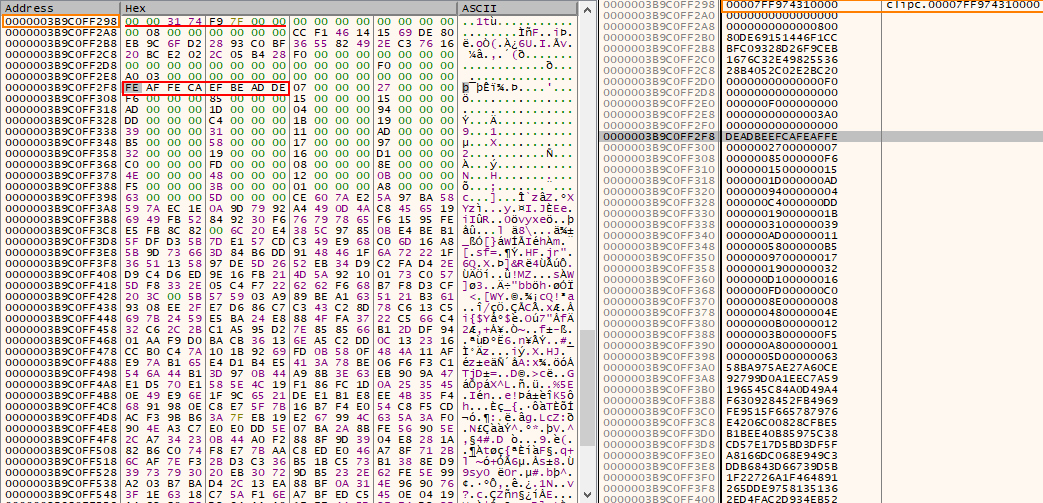
⠀
According to the official documentation, the first parameter of NtQuerySystemInformation is of type SYSTEM_INFORMATION_CLASS which specifies the category of system information to be queried. During static analysis in IDA Pro, this parameter was initially identified as SystemExtendedProcessInformation|0x80 but looking for this value in MSDN and other public references didn’t provide any explanation on how the execution was achieved. But, searching for the original value passed to the function (0xB9) uncovered something interesting. The following blog by DownWithUp covers Microsoft Warbird, which could be described as an internal code protection and obfuscation framework. These resources confirm IDA misinterpretation of the argument which should be SystemCodeFlowTransition, a necessary argument to invoke Warbird functionality. Additionally, DownWithUp’s blog post mentioned the possible operations:
⠀
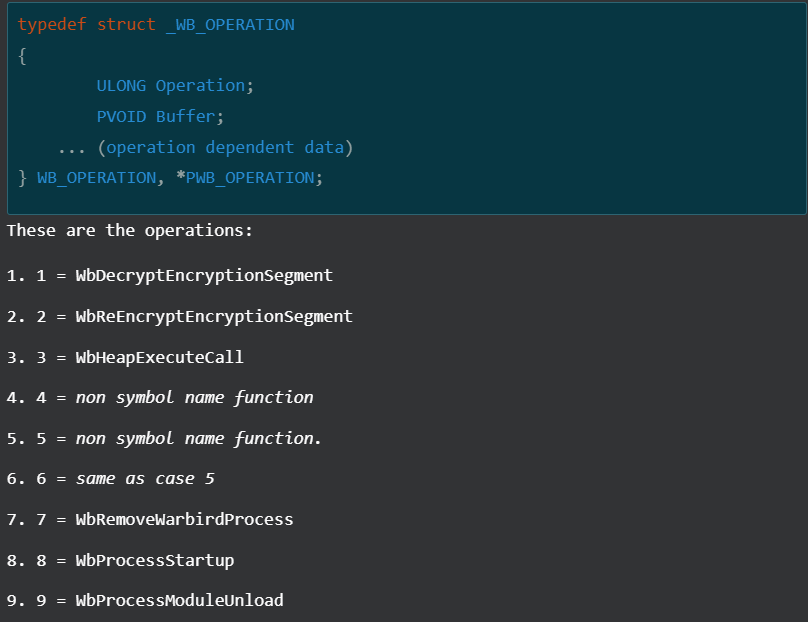
⠀
Referring to the snippet we saw from “ConsoleApplication2.exe”, the operation is equal to WbHeapExecuteCall which gives us the answer on how the shellcode gained execution. Thanks to work of other researchers, we also know that this technique only works if the code resides inside of memory of Microsoft signed binary, thus revealing why clipc.dll has been used. The blog post from cirosec also contains a link for their POC of this technique which is almost the same replica of “ConsoleApplication2.exe”, hinting that author of “ConsoleApplication2.exe” simply copied it and modified to execute Metasploit block_api shellcode instead of the benign calc from POC. The comparison of the Cobalt Strike beacon configuration delivered via “conf.c” and “ConsoleApplication2.exe” revealed shared trades between these two, most notably domain, public key, and process injection technique.
Attribution to Lotus Blossom
Attribution is primarily based on strong similarities between the initial loader observed in this intrusion and previously published Symantec research. Particularly the use of a renamed “Bitdefender Submission Wizard” to side-load “log.dll” for decrypting and executing an additional payload.
In addition, similarities of the execution chain of “conf.c” retrieved from the infected asset and other loaders that we found, supported by the same public key extracted from CS beacons delivered through “conf.c” and “ConsoleApplication2.exe” suggests with moderate confidence, that the threat actor behind this campaign is likely Lotus Blossom.
Conclusion
The discovery of the Chrysalis backdoor and the Warbird loader highlights an evolution in Lotus Blossom's capabilities. While the group continues to rely on proven techniques like DLL sideloading and service persistence, their multi-layered shellcode loader and integration of undocumented system calls (NtQuerySystemInformation) mark a clear shift toward more resilient and stealth tradecraft.
What stands out is the mix of tools: the deployment of custom malware (Chrysalis) alongside commodity frameworks like Metasploit and Cobalt Strike, together with the rapid adaptation of public research (specifically the abuse of Microsoft Warbird). This demonstrates that Lotus Blossom is actively updating their playbook to stay ahead of modern detection.
Rapid7 customers
InsightIDR and MDR
InsightIDR and Managed Detection and Response customers have existing detection coverage through Rapid7's expansive library of detection rules. Suspicious Process - Child of Notepad++ Updater (gup.exe) and Suspicious Process - Chrysalis Backdoor are two examples of deployed detections that will alert on behavior related to Chrysalis. Rapid7 will also continue to iterate detections as new variants emerge, giving customers continuous protection without manual tuning.
Intelligence Hub
Customers using Rapid7’s Intelligence Hub gain direct access to Chrysalis backdoor, Metasploit loaders and Cobalt Strike IOCs, including any future indicators as they are identified.
Indicators of compromise (IoCs)
File indicators
Note: data may appear cut-off or hidden due to the string lengths in column 2. You can copy the full string by highlighting what is visible.
update.exe | a511be5164dc1122fb5a7daa3eef9467e43d8458425b15a640235796006590c9 |
[NSIS.nsi] | 8ea8b83645fba6e23d48075a0d3fc73ad2ba515b4536710cda4f1f232718f53e |
BluetoothService.exe | 2da00de67720f5f13b17e9d985fe70f10f153da60c9ab1086fe58f069a156924 |
BluetoothService | 77bfea78def679aa1117f569a35e8fd1542df21f7e00e27f192c907e61d63a2e |
log.dll | 3bdc4c0637591533f1d4198a72a33426c01f69bd2e15ceee547866f65e26b7ad |
u.bat | 9276594e73cda1c69b7d265b3f08dc8fa84bf2d6599086b9acc0bb3745146600 |
conf.c | f4d829739f2d6ba7e3ede83dad428a0ced1a703ec582fc73a4eee3df3704629a |
libtcc.dll | 4a52570eeaf9d27722377865df312e295a7a23c3b6eb991944c2ecd707cc9906 |
admin | 831e1ea13a1bd405f5bda2b9d8f2265f7b1db6c668dd2165ccc8a9c4c15ea7dd |
loader1 | 0a9b8df968df41920b6ff07785cbfebe8bda29e6b512c94a3b2a83d10014d2fd |
uffhxpSy | 4c2ea8193f4a5db63b897a2d3ce127cc5d89687f380b97a1d91e0c8db542e4f8 |
loader2 | e7cd605568c38bd6e0aba31045e1633205d0598c607a855e2e1bca4cca1c6eda |
3yzr31vk | 078a9e5c6c787e5532a7e728720cbafee9021bfec4a30e3c2be110748d7c43c5 |
ConsoleApplication2.exe | b4169a831292e245ebdffedd5820584d73b129411546e7d3eccf4663d5fc5be3 |
system | 7add554a98d3a99b319f2127688356c1283ed073a084805f14e33b4f6a6126fd |
s047t5g.exe | fcc2765305bcd213b7558025b2039df2265c3e0b6401e4833123c461df2de51a |
Network indicators
95.179.213.0 |
api[.]skycloudcenter[.]com |
api[.]wiresguard[.]com |
61.4.102.97 |
59.110.7.32 |
124.222.137.114 |
MITRE TTPs
ATT&CK ID | Name |
T1204.002 | User Execution: Malicious File |
T1036 | Masquerading |
T1027 | Obfuscated Files or Information |
T1027.007 | Obfuscated Files or Information: Dynamic API Resolution |
T1140 | Deobfuscate/Decode Files or Information |
T1574.002 | DLL Side-Loading |
T1106 | Native API |
T1055 | Process Injection |
T1620 | Reflective Code Loading |
T1059.003 | Command and Scripting Interpreter: Windows Command Shell |
T1083 | File and Directory Discovery |
T1005 | Data from Local System |
T1105 | Ingress Tool Transfer |
T1041 | Exfiltration Over C2 Channel |
T1071.001 | Application Layer Protocol: Web Protocols (HTTP/HTTPS) |
T1573 | Encrypted Channel |
T1547.001 | Boot or Logon Autostart Execution: Registry Run Keys |
T1543.003 | Create or Modify System Process: Windows Service |
T1480.002 | Execution Guardrails: Mutual Exclusion |
T1070.004 | Indicator Removal on Host: File Deletion |
*IOCs contributed by @AIexGP on X.
Mitigation guidance
Rapid7 recommends updating to the latest version of Notepad++. In addition, the IoCs provided above and within Rapid7 Intelligence Hub can be used to hunt within your logs during the timeframe of June through November, 2025, as this is the timeframe when the backdoor activity is known to have been taking place.
Interested in learning more?
Catch Inside Chrysalis, Rapid7's webinar led by Christiaan Beek, on-demand via BrightTALK.


Related blog posts

Threat Research
New Whitepaper: Stealthy BPFDoor Variants are a Needle That Looks Like Hay

Rapid7 Labs

Threat Research
BPFdoor in Telecom Networks: Sleeper Cells in the Backbone
Rapid7 Labs

Threat Research
New Whitepaper: Exploiting Cellular-based IoT Devices

Deral Heiland

Vulnerabilities and Exploits
CVE-2026-31381, CVE-2026-31382: Gainsight Assist Information Disclosure and Cross-Site Scripting (FIXED)
Christopher O’Boyle