
Rapid7 MDR
Proactive Threat Hunting
Backed by insights from millions of customer endpoints, our research team, and open source communities, proactive hunts through Rapid7 MDR keep you ahead of fast-moving threats.
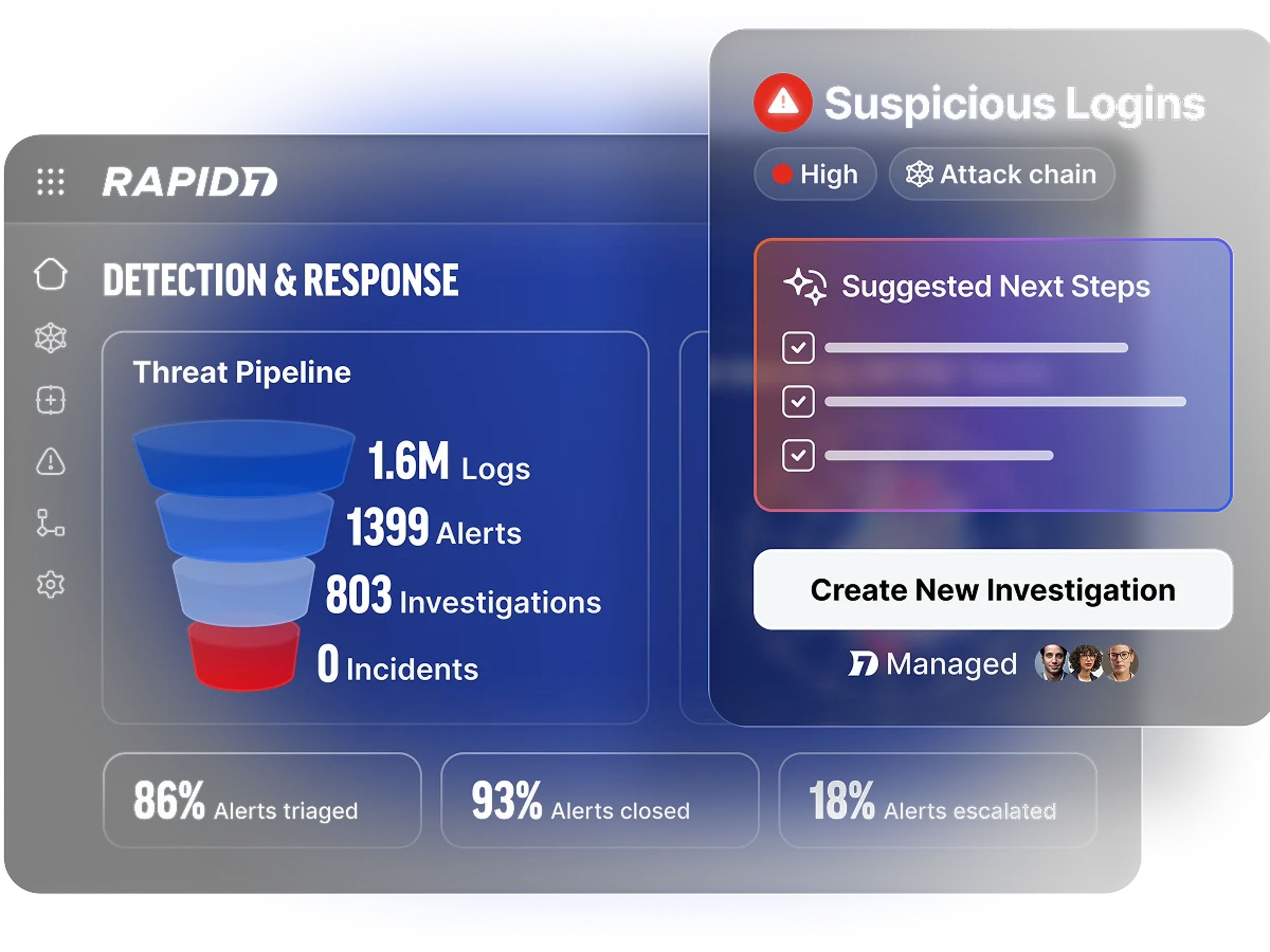
Sophisticated attacks require intelligent hunts
Managed threat hunting is critical when breakout times are accelerating, novel techniques evade detection, and intrusions occur across domains.

AI is compressing attack timelines
Attackers are intruding at machine speed, causing operational impact in seconds and minutes – not hours or days.

TTPs are evolving, rapidly
New and increasingly sophisticated attack techniques are becoming more accessible to more threat actors.

Attack paths span your environment
Adversaries move seamlessly across endpoint, identity, cloud, network, and SaaS – not just targeting a single domain.
AI is compressing attack timelines
Attackers are intruding at machine speed, causing operational impact in seconds and minutes – not hours or days.
TTPs are evolving, rapidly
New and increasingly sophisticated attack techniques are becoming more accessible to more threat actors.
Attack paths span your environment
Adversaries move seamlessly across endpoint, identity, cloud, network, and SaaS – not just targeting a single domain.
Hunt adversaries and disrupt attacks
Combine real world-intelligence, continuous data analysis, integrated response, and rapid detection creation to uncover and preempt novel threats.
Reveal what matters most
Proprietary intelligence reveals zero days and new IOCs as they surface, delivering the earliest possible protection.


.webp&w=3840&q=75)
How proactive threat hunting compares
| Capability | Traditional MDR | Rapid7 MDR |
|---|---|---|
| Threat hunting approach | Reactive hunting performed on fixed schedules after alerts trigger | Proactive, hypothesis-based hunting driven by proprietary intelligence |
| Threat intelligence | Relies on third-party feeds and publicly available indicators | Powered by Rapid7 Intelligence, emergent CVEs, and customer-driven intelligence |
| Attack surface | Primarily focused on endpoint telemetry and alert activity | Cross-domain visibility across endpoint, identity, cloud, network, and SaaS |
| Detection support | Static detections updated periodically through standard content releases | Continuously evolving detections developed from emerging attacker behavior |
| Incident response | Requires a separate IR retainer or disconnected escalation process | Integrated response with seamless MDR-to-IR escalation and remediation |
| Tooling | Query language-based log search requiring specialized expertise | AI-powered, natural language log search and built-in Velociraptor for deep digital forensics |
Explore Rapid7 MDR
See how Rapid7 MDR incorporates proactive threat hunting to help teams uncover and stay ahead of emerging threats, disrupting more attacks and building lasting cyber resilience.

Resources
Explore how Rapid7 approaches threat hunting, investigation, and response.



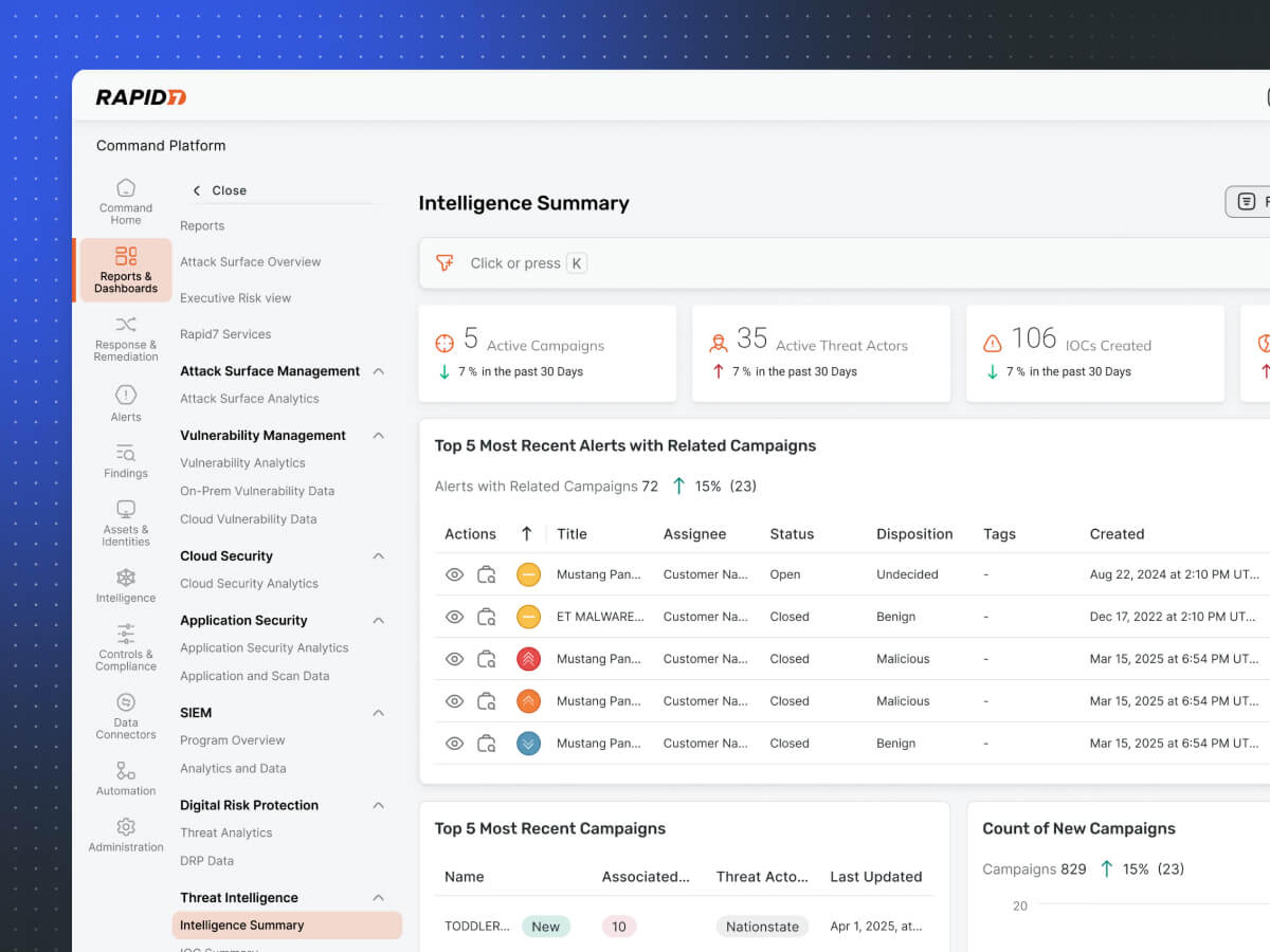

Hunt or Be Hunted: Frontline Tales of Detection
Security incidents don’t unfold in clean, linear steps – and neither do the decisions that stop them. In this webcast, we walk through a real-world incident to show how SOC teams actually operate under pressure.
Frequently asked questions

See how Rapid7 MDR stops threats earlier
Talk with Rapid7 about how proactive, exposure-aware MDR helps your team find threats earlier, reduce noise, and respond with confidence.